

Our Sliding Scale Fee Structure
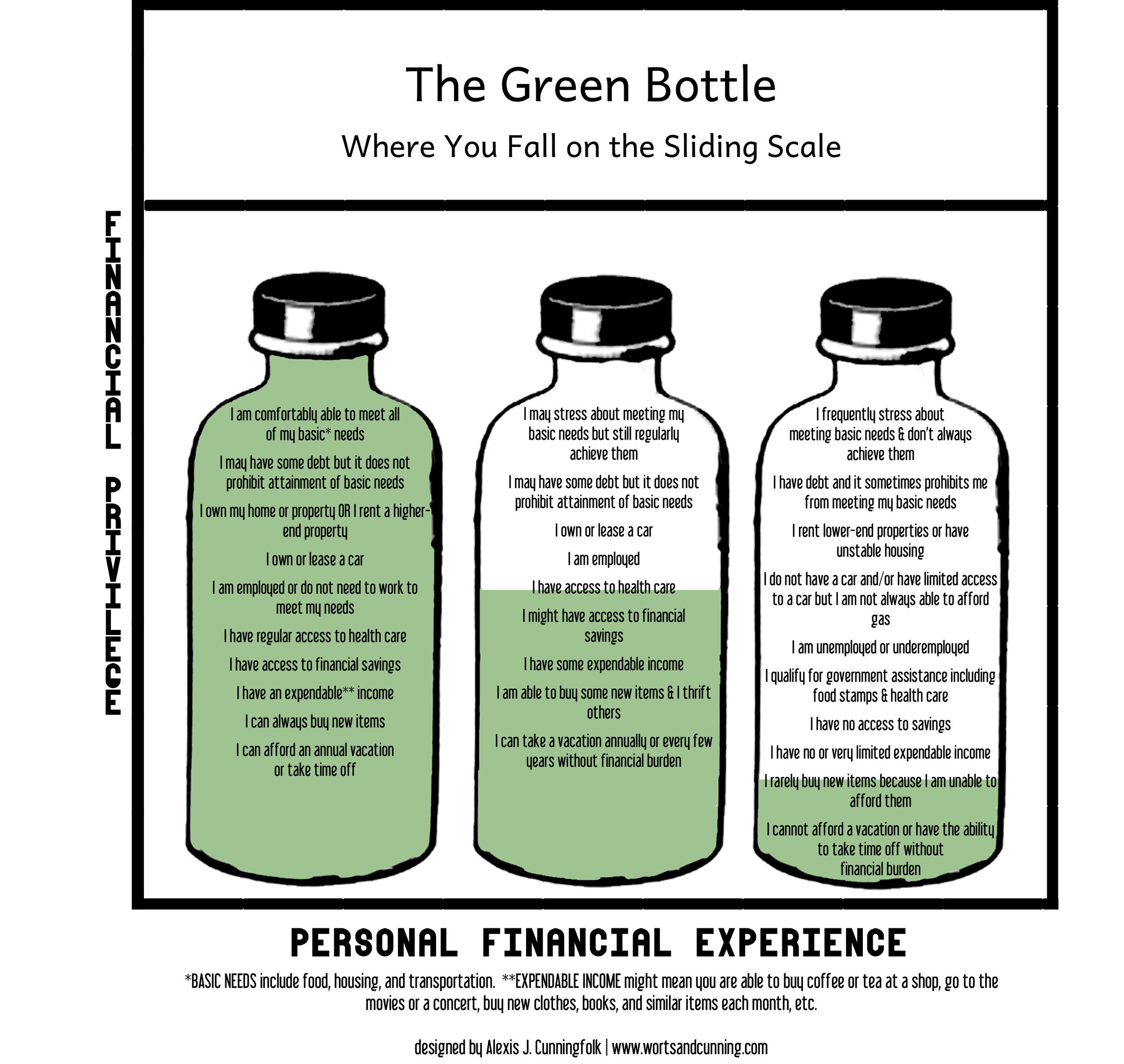
We are dedicated to working in community with the people we serve and want to create services that are welcoming, tailored to the populations we serve, well-informed, centered in research and that allow our providers to feel good about the work they do without working so hard to make a living that they burn out or risk feeling resentful. As a result, we are dedicated to providing a sliding scale for our fees that allows some people to access services that they might not otherwise be able to afford. This is able to happen because those with more resources are able to subsidize the costs so that people with fewer resources can attend. It also requires people to have honest self-reflection and look at how much they can really afford to do the important work of therapy.
Hardship versus Sacrifice
First, it is important to understand the difference between sacrifice and hardship when looking at access to services. If paying for a service, class or product would be difficult but not detrimental, it qualifies as a sacrifice. Making a sacrifice might mean cutting back on spending in other areas of your life (e.g., buying a new outfit, getting coffee, eating out for meals) but it would not have a long term harmful impact on your life. Making financial sacrifices to do therapy might be something you feel called to do as it will benefit you in many other areas of your life. In contrast, if paying for a class, product or service would lead to a harmful impact on your life (e.g., not being able to pay rent, pay for transportation to work or for food), then it is a hardship. In our system, people who are coming from a space of hardship would typically qualify for the lower end of the sliding scale. It can be challenging to think about class, privilege and access issues, but it feels important to recognize the difference between sacrifices and hardships even as sacrifices can be very challenging.
How we used to do our sliding scale
For many years, we would decide our sliding scale price with our clients by giving them a range of costs from the lowest we could accept given our expenses to our highest cost for private pay clients and asking the client to place themselves on the scale. We were not interested in asking our clients for tax and salary information and making the determination of price on our own because we realize that some people have a lot of medical or student loan debt, are caregiving for others, or have other expenses that are not always immediately known when determining what one can afford for therapy. While we were trying to be sensitive to this difficult discussion, it often left people confused about how much to pay.
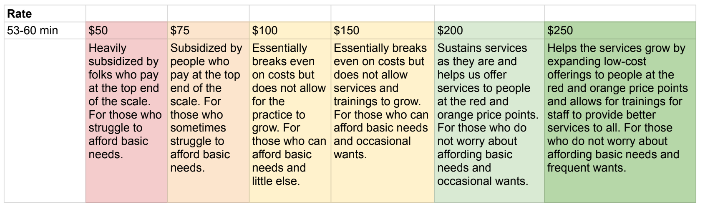
We want to be able to serve a wide variety of people including people from marginalized communities (many of which our therapists belong to as well). We don’t want to offer only fixed prices because we know this can limit who can access services. Sliding scale fees allow people with different financial resources to access therapy while also keeping the work we do sustainable for our therapists and the business. We are coming from a focus on economic justice where people must engage in a thoughtful manner to contribute a similar percentage of their resources. As a result, the upper tiers of the sliding scale subsidize the lower tiers while the true cost of a session falls somewhere near the middle of the scale and reflects fair wages, insurance, facilities, software, and continuing education costs. When people pay according to one’s resources, it helps create a more equitable, diverse and sustainable community.
Factors to consider when deciding how much to pay
We recognize that using a sliding scale fee structure requires self-reflection in an honest and thoughtful way about the complexities of income, debt, wealth, class, race, disability and other forms of inequity that affect someone’s ability to pay for services.
Consider paying less on the scale if you:
Have significant debt
Have significant medical expenses
Have educational expenses
Receive public assistance
Are a senior citizen with a fixed income
Are supporting children or have dependents
Consider paying more on the scale if you:
Own the home you live in
Have investments, retirement accounts or inherited money
Travel recreationally
Have access to family resources in times of need
Share most your expenses with a partner
Work less than full time by choice
Our Sliding Scale
Mutual Aid Food Share
We know that sometimes food can be really hard.
What do I buy?
What if I don’t like it? What if the texture icks me out?
What if it was my safe food and now I’ve burned out on it right after buying a large amount of it?
What if I’m too depressed or anxious or overstimulated to go into a grocery store or fill out a form to have groceries delivered?
What if I went too long without eating and now I can’t make decisions?
We have created a food share program to help with these issues. We think of it as a “need a penny/ take a penny” system for food. We have a small table in the corner of our reception area under the bulletin boards that acts as a place to drop off or pick up shelf stable food/ drinks. You can take as much or as little as you need. You don’t need to ask anyone, you don’t have to prove you “really need it”, you don’t have to be sure you have something to trade. If there is an item on the table that is calling to you, feel free to take it. If you happen to have extra of something, bring it in. It’s really that simple.
*Thanks to Sydney Benator for this wonderful idea.